Buy vs lease solar panels comes down to ownership: buying generally delivers the highest long-term return over 25-30 years, while a lease or PPA leaves the provider owning and servicing the system under a long contract.
Roof material is a separate decision, covered in solar panels vs solar shingles, and this comparison sits within the wider guide to green technology for homes. Buying suits households that plan to stay and want the strongest long-term return. A lease or PPA suits those who value provider maintenance more than return, and only once the contract terms below hold up.
Ownership, lease and PPA compared
| Criterion | Buy (cash or solar loan) | Solar lease | Power purchase agreement |
|---|---|---|---|
| Who owns and services the system | The homeowner | The provider owns and services it; maintenance is included | The provider owns and services it; maintenance is included |
| How payments work | Upfront cash, or loan payments | Monthly payment for the lease term | Monthly rate based on kWh produced |
| Typical term | Loan typically 5 to 20 years | 20-25 years | Typically 10 to 25 years |
| Escalator clause | Not applicable | Usually included; annual increases of 1-3% | Annual increases of 1-3% are typical for leases and PPAs |
| Federal residential clean energy credit | Owned residential systems no longer qualify | Installation still qualifies, but the provider receives the benefit | Installation still qualifies; the provider owns the system |
| At home sale | An owned system can add to the sale price | Typically requires a lease transfer or buyout | A long-term contract can complicate moving or selling |
Figures come from EnergySage’s buy-versus-lease guide and NRG Clean Power’s cash-versus-financing guide.
Buying with cash or a solar loan
Buying means the homeowner holds system ownership from day one. EnergySage puts the average upfront cost at $30,505 before incentives, and because owned residential systems no longer qualify for the federal credit, that figure is the number to plan around.
A solar loan spreads that cost. NRG Clean Power reports loan terms typically run 5 to 20 years, with rates typically 2.99%-8.99% APR. EnergySage gives an illustration of a monthly payment of $220 to $350 for a typical $30K system at 7.5%. Because rates vary across that range, the APR is the figure to compare between lenders before accepting an offer.
How a solar lease and a PPA work
Under both arrangements the solar company owns the system and the household pays for what it produces or for the right to use it. The mechanics differ in what the monthly bill is based on.
Solar lease
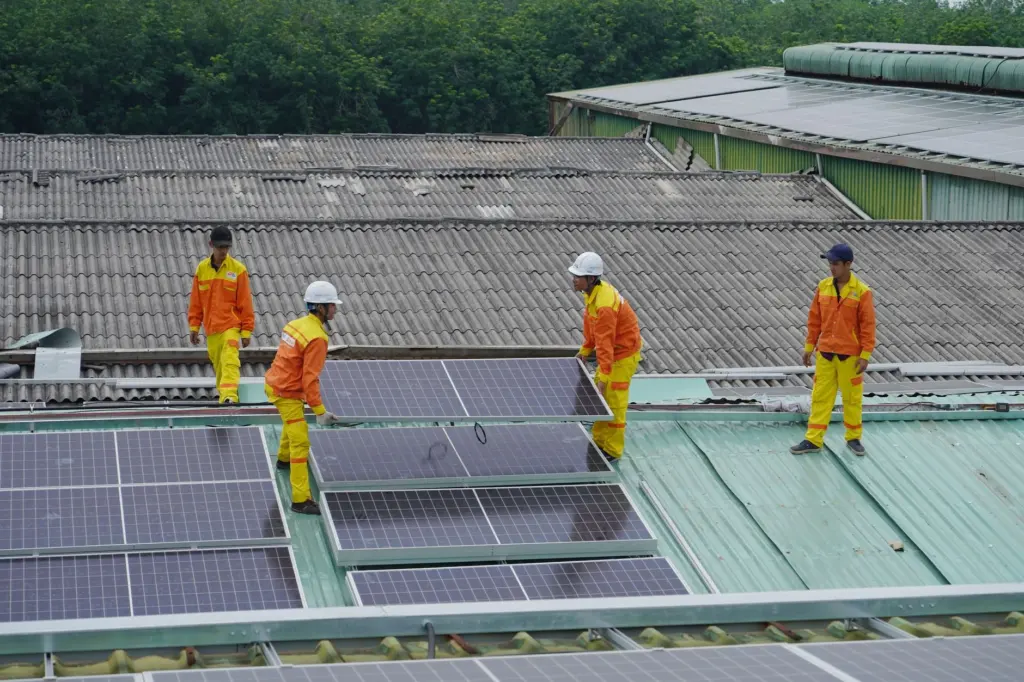
A lease is a rental of the equipment. EnergySage describes monthly payments for 20-25 years, with the provider keeping ownership throughout. NRG Clean Power says lease payments stay the same each month, which makes budgeting predictable, while SolarReviews notes that leases usually include a price escalator. The escalator clause is therefore the term that decides whether a lease stays predictable.
Power purchase agreement
A power purchase agreement replaces the loan or rental payment with a charge for output. NRG Clean Power explains that instead of a loan payment, the household pays a monthly rate based on how much electricity the panels produce, and that contract length is typically 10 to 25 years. A PPA suits a household that prefers to pay for generation rather than equipment, but the bill moves with production, so the rate per kWh and any escalator matter more than a headline monthly figure.
Who receives the federal residential clean energy credit
The party that owns the system is the party that benefits. EnergySage states that solar leases and PPAs are now the only residential solar installations that still qualify for the federal tax credit, and SolarReviews adds that the installer you lease with gets the benefit of tax incentives and rebates, not you.
For a homeowner, the credit is therefore not a reason to lease. It is a reason to ask how the provider’s incentive is reflected in the monthly rate. Incentives for other upgrades are covered in heat pump rebates and tax credits.
Solar lease pros and cons
- Pro: the provider handles the equipment. NRG Clean Power lists maintenance as included by the provider under a PPA or lease, which suits households that do not want to manage repairs.
- Pro: budgeting can be simple. A fixed monthly payment is easy to plan around, provided the contract’s escalator is low.
- Con: payments can climb. Annual increases are built into many leases and PPAs, so the cost in later years is higher than in year one.
- Con: the homeowner does not receive the incentive. The lessor claims it, as covered above.
- Con: the commitment is long. A term that can run into the 20-25 year lease range outlasts many households’ time in one home, which is what makes a sale harder.
Contract-term checklist before signing

EnergySage advises taking time to review the contract terms, understand escalator clauses and compare offers from multiple providers. The list below turns that into specific questions to put to any lease or PPA provider.

- Find the escalator clause. Escalators are described as annual rate increases of 1-3% that boost the monthly payment each year, and EnergySage recommends looking for providers with escalators of 1% or less.
- Confirm the term. Compare the stated length with the typical ranges in the table above, since the length of the commitment drives the sale complications.
- Identify the payment basis. Establish whether the charge is a flat monthly payment or a per-kWh rate, and how that rate is set.
- Check who maintains the system. Confirm in writing that maintenance is included by the provider.
- Ask about transfer and buyout. Find out what the provider requires if the home is sold, before signing rather than at listing.
- Ask who holds the incentive. Confirm that the provider claims the credit and ask how that is reflected in pricing.
- Collect competing offers. Use the escalator, term and payment basis as the common points of comparison.
Selling a home with solar
Home sale transfer is where ownership and leasing diverge most. A homeowner with an owned system has an asset to sell, while a lease or PPA customer has a contract to hand over or end.
Owned system
EnergySage reports that homes with owned solar panels sell for 5-10% more than comparable homes without solar, and cites SolarInsure research that owned systems boost home values by up to $79,000. The $79,000 figure is a ceiling, not a typical result, so it is better used as an upper bound than a planning target.
Leased or PPA system
EnergySage notes that a lease typically requires a lease transfer or buyout, which can complicate the process. NRG Clean Power makes the same point for long-term contracts generally: moving or selling your home can be complicated. For pre-paid leases, EnergySage adds that federal rules require the system to remain under third-party ownership for at least five years. Households that expect to move should raise transfer terms with the provider early, and treat an uncertain answer as a reason to favour buying.
Which option suits which household
- Buy with cash if the household expects to stay and wants the highest long-term return, since ownership is the route that generally delivers it.
- Buy with a solar loan if upfront cash is the barrier but ownership is still the goal; compare APRs and check the monthly payment against current electricity spending.
- Choose a lease if provider maintenance and a steady payment matter more than return, and the escalator is at the low end of the range.
- Choose a PPA if paying for production rather than equipment appeals, with the per-kWh rate and escalator checked against competing offers.
- Wait or choose another route if a move is likely in the near term, because lease and PPA transfers add friction that ownership avoids.
Frequently asked questions
How long until a purchased system pays for itself?
NRG Clean Power gives the average break-even point as 7-8 years for cash buyers and 9-11 years for financed systems.
Do homes with solar sell faster?
SolarReviews says homes with solar panels sell 20% faster and for 17% more money. That figure covers homes with solar generally, and a leased system arrives with a contract that the buyer must accept.
Can the solar company refuse the buyer of a leased system?
Yes, it can. SolarReviews notes that the solar company can deny new homeowners from entering the contract based on their credit score, so a prospective buyer’s approval is a risk to raise with the provider early.